Grokking: the jump from memory to rule
A small neural network learns to add numbers below 53. Inside it there are 56,320 numbers, and training only changes those.
After 1,000 steps it answers 93% of the sums it trained on, and 32% of the sums it has never seen. Guessing would give 1.9%, because there are 53 possible answers. So the network has learned its training sums by heart and nothing about the rest.
Then the rest arrives. Between step 1,000 and step 3,000 the accuracy on the unseen sums rises from 32% to 94%. At step 5,000 it is 99%. From step 7,500 it is 100%, so all 1,966 sums it never saw come out right.
That late jump is grokking. The name comes from Grokking: Generalization Beyond Overfitting on Small Algorithmic Datasets (Power et al., 2022), which saw it in small networks trained on small algorithmic tasks. The network is a transformer with one layer, the same family as the models behind chat programs. The experiment is two C# files and takes about 90 seconds on one core.
The task
The answer is always a number from 0 to 52. When a sum reaches 53 or more, subtract 53:
12 + 35 = 47           already below 53
40 + 30 = 70   →  17
50 + 50 = 100  →  47
The network reads five symbols: a start mark, the first number, +, the second number and =. It gives a score to each of the 53 possible answers, and the highest score is the answer.
There are 2,809 sums, because each first number from 0 to 52 can go with each second number from 0 to 52. I train on 843 of them and keep the other 1,966 out of sight. A network can always repeat a sum it has seen, so the unseen sums are the only proof that it learned addition.
The jump
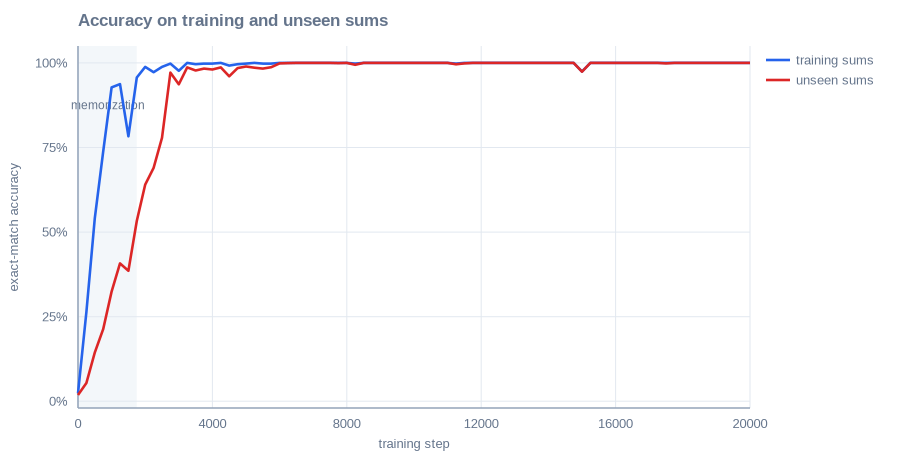
The blue line is the training sums, and the red line is the unseen ones. By step 1,000 the blue line is at 93% and the red line at 32%. Then the red line climbs, slowly at first and then fast, and the two lines meet near step 4,000.
The interesting part is what happens between step 1,000 and step 3,000. The network is not stuck. It already knows the answers to its own sums. During those steps it slowly replaces what it memorized with a rule that also works for the sums it has not seen.
Why it happens
Two different solutions can explain the 843 training sums. The first is a table: store the answer to each of them. It is quick, and it says nothing about a sum that is not in the table. The second is addition itself, which answers every sum.
Both are possible, and the training has no preference between them. Adam, the usual optimizer, only pushes each answer to be a little less wrong at each step. What decides here is weight decay: at every step the training also pulls the numbers a little towards zero. A table needs big numbers, one for each stored answer, while addition needs smaller ones. So the table becomes more expensive as the run goes on, and the cheaper solution wins.
This figure shows it:
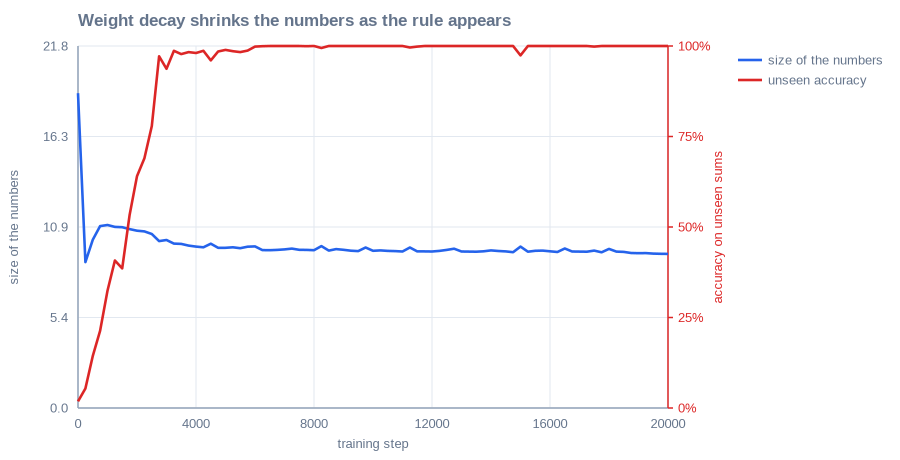
The size falls from 18.9 to 8.8 in the first 250 steps, climbs to 11.0 while the network memorizes, and settles at 9.3 when addition takes over.
Where the decay goes
The same decay can give different results, depending on how the optimizer applies it. Here the decay is part of the same update that each step makes. The other common way is to shrink the numbers after the step, which is what the AdamW optimizer does. With AdamW this run never learns addition. It ends at 30.9% on the unseen sums, the same as the run with no decay at all, and the numbers end at a size of about 56 instead of 9.3.
So weight decay means two different things, and one of them does nothing here.
The control
With the decay at zero, the network memorizes the 843 sums and stops there. From step 2,000 to step 20,000, the accuracy on the unseen sums stays between 30.6% and 30.9%. The size of the numbers grows to 61, because nothing charges for them. With the decay, the same run ends at 100%, with a size of 9.3.
The model
The network is the one from microgpt, by Andrej Karpathy: a transformer with one layer. TorchSharp computes how much to change each number at every step, so the model is one class and the training loop is a handful of lines.
Reproduce it
You need the .NET SDK 11 or newer. The first build downloads PyTorch’s native library, a few hundred megabytes.
git clone https://github.com/jacano/grokking-torchsharp
cd grokking-torchsharp
make run
The run takes about 90 seconds and writes a CSV with one row per step and the figures of this article. The last 2,000 of its 20,000 steps make the changes smaller and smaller, down to zero. So the run stops on the solution it found, instead of jumping around it.
After training, make save writes the network to disk and make infer asks for a sum:
make infer PAIR=12+35inference 12+35 = 47 [ok] top: 47 (89%), 21 (2%), 52 (2%)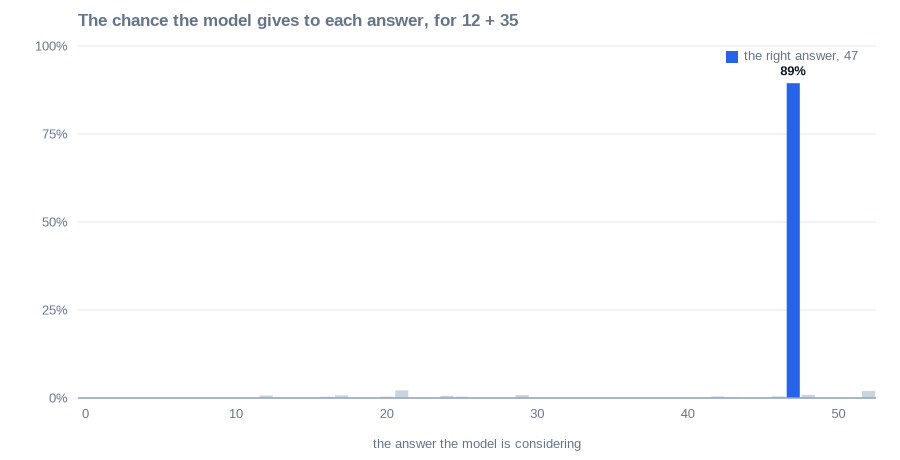
12 + 35 is one of the sums held back from training, so the 89% on 47 is addition at work, not a stored answer.
What I take from this
Accuracy on the training sums says little on its own. In this run, weight decay decides between a table and the rule.
I am not a machine learning researcher. This was a small experiment, which I could reproduce from start to end, understand and enjoy watching. The code, the data and the logs are in github.com/jacano/grokking-torchsharp, so anyone who wants to see it happen can run it in a minute and a half.